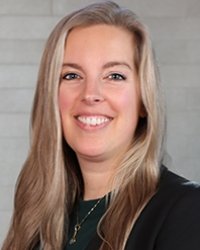
Lauren A. M. Lebois, PhD
Director, Dissociative Disorders and Trauma Research Program
- Assistant Professor of Psychiatry
Biography
Lauren A. M. Lebois, PhD, is a cognitive neuroscientist focused on how the mind, brain, and body adapt following trauma. She prioritizes translating scientific advances into accessible, compelling, and clinically relevant insights. Her National Institute of Mental Health-funded research program examines the neurobiology of dissociation across trauma spectrum disorders, with published work on mindfulness, learning and plasticity in emotion, and brain-behavioral correlates of dissociation.
Dr. Lebois is a former chair of the Scientific Committee for the International Society for the Study of Trauma and Dissociation (ISSTD), an ISSTD fellow, and co-director of the Initiative for Integrated Trauma Research, Care, and Training at McLean Hospital. She has received multiple honors for her research, including McLean Hospital’s Alfred Pope Award for Young Investigators, ISSTD’s Pierre Janet Writing Award, the Morton Prince Award, and the President’s Award of Distinction. Her work aims to reduce stigma and improve care for individuals living with post-traumatic stress disorder and dissociative identity disorder.
The Dissociative Disorders and Trauma Research Program, founded in 2013 by Dr. Milissa Kaufman and jointly directed by Dr. Kaufman and Dr. Lauren Lebois, is dedicated to improving how trauma-related conditions are understood, identified, and treated. The lab focuses on individuals with histories of childhood trauma who experience dissociative symptoms—such as memory gaps, emotional numbing, feeling disconnected from one’s body or surroundings, and identity alteration—that are common in post-traumatic stress disorder (PTSD) and dissociative identity disorder (DID).
Despite being common and clinically significant, dissociative symptoms are frequently overlooked or misunderstood in medical and mental health settings. This contributes to delayed diagnosis, ineffective treatment, and significant distress for patients. A central goal of the lab’s work is to reduce these gaps by providing scientifically grounded evidence that improves assessment, guides treatment decisions, and reduces stigma surrounding dissociation.
The group’s research integrates lived experience, behavioral science, brain imaging, physiology, and genetics to better characterize the diverse ways people adapt to trauma. By documenting how dissociative symptoms differ across individuals—and how they relate to functioning and recovery—we aim to move beyond one-size-fits-all approaches to trauma care. This work supports more precise, personalized interventions and helps clinicians identify which patients are most likely to benefit from particular treatments.
A major focus of the lab is identifying biological markers of trauma-related dissociation that can be used to support earlier identification and intervention. Study findings show that dissociation reflects distinct, measurable brain-based and physiological processes rather than purely subjective experiences. They have demonstrated that patterns of brain connectivity can predict dissociative symptoms and that these markers help identify individuals at risk for more severe or persistent PTSD symptoms over time. These insights open the door to new treatment targets and objective tools to track clinical change.
The lab also conducts rigorous research on DID, a highly stigmatized condition that is more prevalent than commonly recognized and strongly linked to chronic childhood maltreatment. Individuals with DID often wait many years for an accurate diagnosis. Their work contributes objective evidence about the neurobiological and perceptual features of DID, helping to counter misinformation that has historically limited access to appropriate care.
Finally, through participation in large-scale, international research collaborations, the investigators work to ensure that discoveries translate beyond the laboratory into real-world clinical practice. By identifying brain-based and genetic markers of trauma-related disorders, the lab aims to improve trauma-informed care, clinical training, and ultimately enhance outcomes for individuals and families affected by trauma.
- Cori Palermo, MA, Lab Manager
- Xi Pan, LICSW, MPA, Clinical Research Assistant
- Justin T. Baker, MD, PhD, McLean Hospital
- Nikolaos Daskalakis, MD, PhD, McLean Hospital
- Nathaniel G. Harnett, PhD, McLean Hospital
- Poornima Kumar, PhD, McLean Hospital
- Milissa Kaufman, MD, PhD, McLean Hospital
- Hesheng Liu, PhD, Massachusetts General Hospital
- Lisa Nickerson, PhD, McLean Hospital
- Kerry J. Ressler, MD, PhD, McLean Hospital
- Matthew A. Robinson, PhD, McLean Hospital
- Sherry Winternitz, MD, McLean Hospital
Fenster R, Lebois LAM, Ressler KJ, Suh J. Brain circuit dysfunction in post-traumatic stress disorder: from mouse to man. Nature Reviews. Neuroscience. 2018;19(9):535-551.
Lebois LAM, Palermo CA, Scheuer LS, Lebois EP, Winternitz SR, Germine L, Kaufman ML. Higher integration scores are associated with facial emotion perception differences in dissociative identity disorder. Journal of Psychiatric Research. 2020;123:164-170.
Lebois LAM, Li M, Baker JT, Wolff JD, Wang D, Lambros A, Grinspoon E, Winternitz S, Ren J, Gonenc A, Gruber S, Ressler KJ, Liu H, Kaufman ML. Large-scale brain network architecture changes associated with trauma-related dissociation. American Journal of Psychiatry. 2021;178(2):165-173.
Education & Training
- 2008 BA in Psychology and Irish Studies, University of Notre Dame
- 2010 MA in Cognitive Psychology, Emory University
- 2014 PhD in Cognitive Psychology, Emory University
- 2015-2018 Post-Doctoral Research Fellow, McLean Hospital