
Mei-Hua Hall, PhD
Director, Psychosis Neurobiology Laboratory
- Associate Professor of Psychiatry
Biography
Mei-Hua Hall, PhD, is the director of the Psychosis Neurobiology Laboratory at McLean Hospital and a member of the American College of Neuropsychopharmacology. She has expertise in electrophysiology, psychiatric genetics, and cognitive neuroscience, along with a background in clinical psychology, epidemiology, and statistical modeling. Dr. Hall uses electrophysiology (EEG) and neuroimaging techniques to study the neurobiological mechanisms underlying schizophrenia, bipolar, and psychotic disorders. Her lab uses multimodal approaches to link patients’ neurobiological and clinical profiles with their functional recovery trajectories. The overarching goals of her lab are to identify individuals with different functional recovery paths and to develop individually tailored and effective treatments.
Dr. Hall has received several awards for her research, including the Jerome Lyle Rappaport Research Award, the Harvard Catalyst Clinical Research Center (HCCRC) Research Award, the McLean Hospital Alfred Pope Award, the APPA Scholarship Award, and many others. She collaborates with scientists internationally and serves as an advisor and mentor to undergraduate and graduate students, post-doctoral fellows, and research scientists in her lab and at overseas institutions.
Dr. Hall’s Psychosis Neurobiology Laboratory was founded in 2013. Her lab focuses on two interconnected areas of research. One area is geared toward deepening our understanding of the neurobiological underpinnings of psychotic disorders and mapping out the trajectories of patient recovery. The second area leverages the power of machine learning (ML) and natural language processing (NLP) to delve into the vast information contained in patients’ electronic health records (EHR).
The objective is to develop cutting-edge NLP-based tools for risk prediction and to provide valuable clinical and computational resources to the psychiatric community.
Dr. Hall receives funding from the National Institute of Mental Health and other sources for her research.
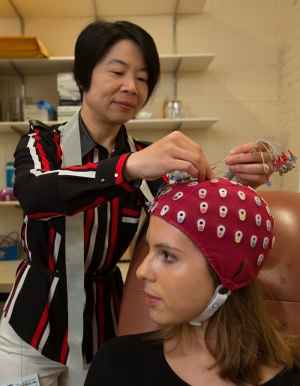
Dr. Hall’s lab is currently conducting several projects. One project uses an integrative approach, combining neurophysiological, neurochemical, genetics, clinical, and behavioral measures to understand the neurobiological mechanisms underlying schizophrenia and bipolar disorder. This project also aims to clarify how genetic and environmental risk factors influence psychopathology, neurocognitive traits, and brain function.
Robust genome-wide genetic studies have identified many risk genes and variations within those genes associated with schizophrenia and bipolar disorder, though their effects on the brain are largely unknown. The lab collects a variety of neurophysiological, clinical, and cognitive functioning data on patients with these disorders. The goal is to link genetic risk factors associated with psychosis disorders to brain neurophysiological characteristics.
Through collaboration with the Broad Institute Stanley Center, the lab investigates the relationships between genetic risks in patients with schizophrenia and bipolar disorder, as well as specific biomarkers, including sleep spindles, auditory evoked related potential responses, and neurocognitive measures, to elucidate the underlying mechanisms.
Another project of the lab uses multimodal approaches to stratify patients who experience their first episode psychosis into homogeneous subgroups based on patients’ unique neurobiological profiles and to relate these profiles to later functional recovery outcomes. This study longitudinally follows up with patients at the early stage of their illnesses every six months for two years. An expanded biomarker panel (cognition, MRI, EEG, clinical symptoms) and functional outcome measures are collected in each patient. The goals are to identify and better characterize individual longitudinal patterns of functioning recovery and to explore the potential risk and protective factors associated with functioning outcomes.
In addition, the lab uses a computerized cognitive training program for patients with schizophrenia and bipolar disorder with the goal of improving certain cognitive functions (such as memory and attention) and psychosocial outcomes. In recent years, training programs based on learning-induced neuroplasticity have shown promising improvement effects on cognitive function.
This suggests that cognitive rehabilitation training induces neurobiological remodeling in brain circuitry relevant to a range of cognitive functions. This project examines brain changes induced by cognitive training to reveal the underlying mechanisms mediating these changes.
A new line of research focuses on interoception (the processing, interpretation, and regulation of bodily signals by the brain) in psychotic disorders. This project utilizes a multimodal approach (EEG, EKG, psychophysiology, and eye tracking) to characterize interoception and its association with clinical symptoms. The goal is to gain more understanding of the underlying mechanisms that may aid the development of new interventions.
Concurrently, the lab focuses on using natural language processing (NLP) and machine learning techniques to create sharable psychiatric EHR data resources and tools for evaluating and predicting psychosis patient readmission risk as well as risk of harm. This project includes experts in psychiatry and computational linguistics.
Manual chart review is impractical and not cost-effective, so the lab has developed a “computational version of chart reviews” pipeline that systematically extracts important clinical features from patient EHRs and converts these data to features for use in training machine learning models relating to trauma and readmission risk factors. In addition, the lab creates a psychiatric-specific temporal relation annotation scheme for building accurate readmission prediction models.
The ultimate goal of these endeavors is to develop precise, actionable tools for clinical practice, enhancing our understanding of the interaction between neurobiological mechanisms and environmental risks in psychotic and mood illnesses.
- Bruce Atwood, Data Analyst
- Eben Holderness, Data Analyst
- Beier Yao, PhD, Research Fellow
Former Personnel:
- Sophie Brickman, BA, Research Assistant, 2016-2018
- Claire Chapman, BA, Research Assistant, 2021-2022
- Shi-Yu Chen, PhD, Post-Doctoral Research Fellow, 2018-2022
- Fyonn Dhang, BA, Research Assistant, 2018-2020
- Cassandra Godzik, Graduate Student Intern, 2016-2017
- Amy Higgins, BA, Research Assistant, 2017-2022
- Shen Li, MD, Post-Doctoral Research Fellow, 2019-2022
- Xiaojing Li, MD, Post-Doctoral Research Fellow, 2017-2018
- Elena Alvarez Mellado, MS, Computational Linguistic Data Analyst, 2019-2020
- Saran Liukasemsarn, Research Data Analyst, 2019-2020
- Mary Lohan, BA, Research Assistant, 2012-2013
- Grace Masters, BA, Research Assistant, 2013-2014
- Sonal Mallya, BA, Research Assistant, 2013-2015
- Elena Alvarez Mellado, MS, Computational Linguistic Data Analyst, 2019-2020
- Nicholas Miller, MS, Computational Linguistic Data Analyst, 2017-2018
- Caitlin K. Monaghan, PhD, Post-Doctoral Research Fellow, 2017-2019
- Nora Mueller, BA, Research Assistant, 2015-2017
- Tain-Huang Zhou, MD, Post-Doctoral Research Fellow, 2015-2017
- Kirsten Bolton, LICSW, McLean Hospital
- Roscoe Brady, MD, Beth Israel Deaconess Medical Center
- Elvira Bramon, MD, University College London, United Kingdom
- Chia-Yen Chen, PhD, Massachusetts General Hospital
- Fei Du, PhD, McLean Hospital
- Robert Freedman, MD, University of Colorado Health Science Center
- Emily Hancock, LCSW, Maine Medical Center
- Kristina Holton, PhD, Harvard Medical School
- Hailiang Huang, PhD, Broad Institute of MIT and Harvard
- Hai-Gwo Hwu, MD, National Taiwan University Hospital, Taipei, Taiwan
- Dilip V. Jeste, MD, Global Research Network on Social Determinants of Health Network
- Matcheri Keshavan, MD, Beth Israel Deaconess Medical Center
- Eugenia Kravariti, PhD, King’s College London, United Kingdom
- Kathryn Eve Lewandowski, PhD, McLean Hospital
- Tao Li, Sichuan University and West China Hospital, PR China
- Dara Manoach, PhD, Massachusetts General Hospital
- Marie M. Meteer, PhD, Brandeis University
- Timothy Miller, PhD, Boston Children’s Hospital
- Dost Öngür, MD, PhD, McLean Hospital
- Jen Pan, Broad Institute of MIT and Harvard
- Diego A. Pizzagalli, PhD, McLean Hospital
- James Pustejovsky, PhD, Brandeis University
- Shaun M Purcell, PhD, Brigham and Women’s Hospital
- Boyu Ren, PhD, McLean Hospital
- Fruhling Rijsdijk, PhD, King’s College London, United Kingdom
- Guergana Savova, PhD, Boston Children’s Hospital
- Jordan Smoller, MD, ScD, Massachusetts General Hospital
- Kevin M. Spencer, PhD, Veteran Affairs Boston Healthcare System
- John Torous, MD, MBI, Beth Israel Deaconess Medical Center,
- Walid Yassin PhD, Beth Israel Deaconess Medical Center
Li S, Chan S-Y, Higgins A, Hall M-H. Sensory gating, neurocognition, social cognition and real-life functioning: a 2-year follow-up of early psychosis. Psychological Medicine. 2023;53(6):2540-2552.
Holton KM, Chan SY, Brockmeier A, Öngür D, Hall M-H. Exploring the influence of functional architecture on cortical thickness networks in early psychosis – a longitudinal study. NeuroImage. 2023;274:120127.
Hall M-H, Xiao Y, Öngür D, Torous J, Jeste DV. Social isolation and loneliness: modern pandemic of a psychosocial determinant of health. Psychiatric Annals. 2024;54(7):e196–e201.
Education & Training
- 1997 BSc in Psychology, University of Lancaster, UK
- 1998 MSc in Psychology, University of London UCL, UK
- 2006 PhD, Institute of Psychiatry, King’s College London, UK
- 2006-2007 Fellowship in Biological and Social/Developmental Psychiatry, NIMH Clinical Research Training Program, McLean Hospital/Harvard Medical School
- 2007-2008 Fellowship in Psychiatry and Neuroscience, McLean Hospital/Harvard Medical School
- 2008-2009 Fellowship in Biological and Social/ Developmental Psychiatry, NIMH Clinical Research Training Program, McLean Hospital/Harvard Medical School