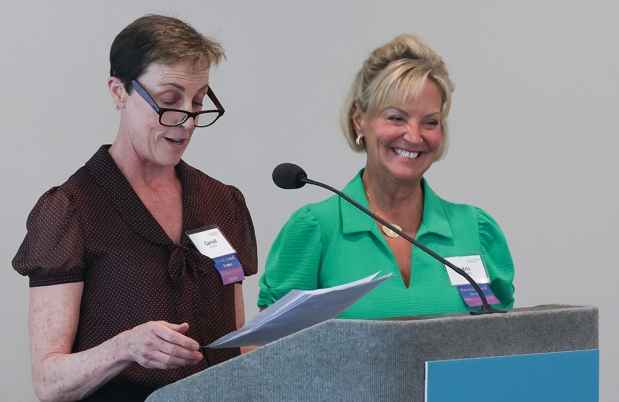
Sisters Teri Gorsky and Beth Stonebraker are steadfast advocates for McLean, using their personal involvement and philanthropy to help drive meaningful change.
Though distinct in personality, they share undeniable common ground: They live just blocks apart in Boston, are both mothers to daughters, and are deeply committed to making quality mental health care accessible—especially for vulnerable populations like women and children.
Teri’s introduction to McLean came through her close friend Laura Weissman Davis, who invited her to an On Women’s Minds luncheon hosted by McLean’s Women’s Mental Health Leadership Council. The experience was transformative.
Moved by the stories of resilience and struggle shared by the women in attendance, Teri knew she had found a cause worth championing. She joined the Leadership Council, and Beth soon followed.
“Beth and I are both big readers—stories help us understand who people are,” Teri shared. “Hearing these women speak with such honesty was eye-opening and sometimes heartbreaking. It reinforced what we’ve always believed—everyone has a story, and those stories deserve to be heard.”
While neither sister has personally experienced severe mental health struggles, they have witnessed its impact within their larger community. Their involvement with McLean has deepened their understanding of mental health, normalizing discussions that were once taboo.

Sisters Teri Gorsky and Beth Stonebraker
Growing up in the 1960s, Teri and Beth lived in a household where, despite a family history of depression, mental health was never openly discussed. Therapy was considered a last resort, and seeking help carried a stigma. “It took years to convince our parents that therapy was a good source of support,” Teri recalled.
Determined to break that cycle, they prioritized mental wellness in their own families. With five daughters between them, they created home environments where mental health was treated as equally important as physical health.
“We’ve always had an open-door policy,” Beth explained. “We wanted our girls to know there’s no shame in sharing their needs and finding ways to meet them.”
They’ve witnessed progress firsthand. Even within the 10-year age gap between their eldest and youngest daughters, they’ve seen public attitudes shift—mental health is no longer a whispered topic, but an open conversation. Through the Women’s Mental Health Leadership Council and their philanthropic support, Beth and Teri are determined to keep pushing this momentum forward.
Among their many philanthropic commitments, McLean holds a special place in their hearts. “So many people are suffering, and access to quality care is critical,” said Teri. “Our own experiences have been relatively mild, but no one is untouched by mental health challenges.”
Beth added, “The conversation must include everyone—from those facing severe mental health conditions to those grappling with anxiety or mild depression. We want to ensure that help is available before a crisis upends someone’s life.”
Their passion for women’s and children’s mental health is rooted in a stark reality: For decades, medical research ignored women’s unique mental health needs. Until the 1990s, clinical trials were largely conducted on men, leaving gaps in understanding and treatment. Learning this history fueled their desire to invest in training the next generation of researchers and clinicians dedicated to advancing women’s mental health care.
Most recently, Beth and Teri made their most substantial contribution yet—an unrestricted gift to The Way Forward Campaign, directed toward McLean’s President’s Campaign Fund.
Their decision reflects their trust in McLean’s leadership and their belief in the urgent need for improved behavioral and mental health care. They also believe deeply that treatment environments matter and are excited for McLean’s plans to build a new child and adolescent campus once the campaign’s goal is met.
“It’s heartbreaking to think of a parent in crisis, leaving their child in a facility that doesn’t match the excellence of McLean’s care,” Teri said. “The campus will be a game-changer for patients, families, clinicians, and researchers alike.”
With every story they hear and every gift they give, the sisters reaffirm their commitment: Mental health matters, and the fight for better care is far from over.
“Mental illness cannot always be treated by love alone,” concluded Teri.