Transcranial magnetic stimulation (TMS) is quickly becoming an important treatment option for severe, treatment-resistant depression and other mental health disorders.
McLean Hospital’s accelerated TMS program makes it more accessible for patients who have restricted schedules. Under the leadership of Joshua C. Brown, MD, PhD, medical director of the Transcranial Magnetic Stimulation Service, director of McLean’s TMS Research in the Division of Depression and Anxiety Disorders, and director of the Brain Stimulation Mechanisms Laboratory, the program has significantly expanded.
Leveraging a unique collaborative culture to drive both clinical and research advancements, “McLean promotes and supports an exceptional work environment,” said Brown. “The research and clinical teamwork are unparalleled, and that is an important part of what drew me here.”
As one of the busiest academic TMS programs in the U.S., McLean’s commitment to growing its academic and clinical capabilities is evident in its innovative efforts, including the development of accelerated TMS protocols.
These advancements promise to increase treatment accessibility and efficacy for patients, while ongoing research aims to optimize TMS applications for a broader range of mental health conditions. Through extensive collaboration within the Mass General Brigham system, McLean continues to enhance patient care and drive transformative change in mental health treatment.
Integrating Clinical and Research Efforts
In January 2023, McLean Hospital appointed Brown its first director of TMS Research to help grow and strengthen the TMS program, supporting the integration of clinical and research efforts, and enhancing the program’s capacity to serve a growing patient population.
“As a physician-scientist, I was attracted to working alongside team members who shared my deep respect for both the clinical and research aspects of our work. At McLean, our colleagues are skilled at optimizing the inherent synergies of those relationships,” he said.
McLean’s TMS program is one of the busiest academic programs in the country, benefiting from a diverse patient population and fueling the rapid innovation of treatment methodologies. This growth is vital for advancing patient care and developing new, effective treatment options.
“McLean’s TMS program offers valuable advantages due to its prominent position as a high-volume academic program,” Brown noted.
“The large volume and patient mix provide unmatched naturalistic de-identified data to analyze, which, in turn, advance opportunities to innovate care at a rapid pace. McLean’s research and clinical areas work hand-in-hand to develop new care methodologies for the benefit of patients who struggle with depression and other disorders.”
McLean’s dedication to grow and strengthen the academic side of its TMS program makes Brown the ideal fit to guide the program into the future and emphasizes the hospital’s resolve to serve a growing patient population.
Stimulating the Brain To Accelerate OCD and Mental Health Relief
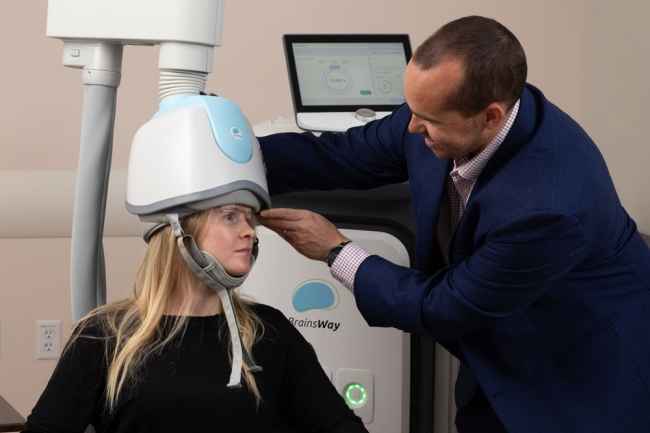
TMS treatment offers patients a safe, noninvasive procedure that delivers magnetic impulses through the scalp to the brain and requires no anesthesia or sedation.
It is used to treat severe treatment-resistant depression and obsessive compulsive disorder (OCD) and is especially helpful for individuals with depression and other mental health challenges that have not improved with medication and talk therapy.
TMS stimulates the brain in the prefrontal cortex—the region of the brain associated with mood regulation.
Brown’s research is focused on guiding TMS parameter selection and pharmacologic augmentation strategies to maximize TMS benefits. His research uses neurophysiology, neuroimaging, and neurobehavioral tasks to measure TMS effects in combination with relevant receptor-modulating drugs.
Brown and his team are widely recognized for trailblazing innovations in TMS and recently launched the accelerated protocols. Accelerated TMS reduces the amount of time it takes for individuals to feel relief from depression.
While a standard course of TMS is 36 outpatient treatments over seven weeks, the accelerated protocols condense outpatient treatments into five days, making it a more viable option for those who work, attend school, or have other logistical limitations.
Positive response rates to standard TMS treatments are up to 60% in individuals with depression. Response rates with accelerated TMS protocols are even higher—up to 85%. For individuals with OCD, around 45% report a partial reduction in symptoms using TMS.
Leveraging Scale for Rapid Treatment Insights
While many TMS colleagues hold multiple roles and affiliations across McLean, Brown has been impressed by the ability of program staff to work as a unified team.
“The dedication and collaboration of McLean’s TMS team is outstanding,” he said.
“This extends to our colleagues doing similar work across the Mass General Brigham system. We work closely with the care teams at Brigham and Women’s Hospital and Mass General Hospital. Together, we are able to achieve greater scale. This collaboration advances knowledge and improves care for all our patients.”
The scale at any site can be an important factor in finding answers to questions about treatment impacts and effectiveness more quickly.
For example, “We were curious if caffeine could have an impact on TMS,” he explained.
“If caffeine blunts brain plasticity, as our prior analysis showed, could it blunt TMS effectiveness? We started asking patients about their caffeine intake last summer and now we have data for nearly 200, which is enough to analyze and answer our question. This would have taken four years at most other centers.”
Brown is thrilled to be increasing patient access to TMS, especially in light of growing demand. Recent studies are predicting large increases in the number of individuals affected by depression disorders.
“We anticipate a growing need for TMS,” said Brown. “We want to get the word out to patients, families, and providers about the transformational impact of this treatment. At McLean, we are already starting inpatients on TMS despite insurance hurdles. It’s inspiring to see a hospital so committed to the patient. The mission to do what is best for the patient is central at McLean.”
McLean’s Vision: Global Leadership To Expand Treatments
McLean’s and Brown’s passion to provide greater access to the very best care guides growth and improvement of TMS treatments at McLean and beyond.
“Looking ahead, we will focus optimization efforts through pharmacologic augmentation and TMS parameter selection. My personal goal is to help improve current rates of remission—meaning individuals no longer meet criteria for depression—with TMS from 30% to 90%. McLean will be a leader in this effort while passing on benefits for patients struggling with devastating depression disorders,” he said.
Brown notes that TMS has the potential to treat any brain disorder involving cortical networks. This potential drives an additional goal.
“I would like to see this research and clinical care extending aid to patients with other disorders, such as substance use disorders, psychosis, anxiety disorders, and eating disorders,” said Brown. “Achieving these goals may be a decade or more in the future, but I am confident that we [as a field] are on track to do so.”
Comprehensive TMS Services in Belmont and Middleborough
McLean is pleased to be able to offer TMS services at both its Belmont main campus and the McLean SouthEast location in Middleborough. The programs provide patients with an option for treatment in a quiet, restorative setting with easy access to other McLean services.
“We have been building the program in Middleborough and recently reached capacity there and now have a waitlist,” Brown shared. “In the coming months, we are looking forward to opening a residential program dedicated to providing accelerated TMS. To our knowledge, this will be the first residential program for accelerated TMS in the world.”
The groundbreaking research and clinical work that is happening at McLean places the hospital as a world leader among TMS programs. “For a physician-scientist, coming to McLean has been everything I had hoped it would be,” said Brown. “The staff is mission driven, unequivocally putting the patient at the center of care. It’s a tremendous professional environment.”
Looking for TMS care for someone struggling with depression, OCD, or other symptoms? Call us today at 617.855.2360 to refer a patient.