Training and education comprise one element of McLean’s tripartite mission, and learning is a unifying thread across all areas of the hospital. At the Nancy and Richard Simches Division of Child and Adolescent Psychiatry, the more people we teach, the broader our influence, as our trainees expand our capacity to help more children and families.
Two initiatives serve to illustrate the value of learning at McLean. One has the colorful name of “Project WearWolf,” the other a more academic moniker: pre-doctoral internships. Both are helping us to serve the needs of younger patients and their families.
“One way to understand brain activity in psychiatric problems is for kids to come into our research lab to receive special MRI brain scans while they make decisions and respond to certain situations,” said Simches Division Chief Daniel P. Dickstein, MD, FAAP. “But we also need to see what brain activity looks like in the real world.”
Wear-Wolves of McLean
Enter Project WearWolf, which employs high-tech, wearable headbands to measure brain activity in kids ages 7-13.
Called functional near-infrared spectroscopy (fNIRS), the headbands use similar technology as the red light on your finger at your primary care doctor to measure oxygen in your blood. There are also wristwatch-like devices that measure stress and changes in heart rate and activity.
“WearWolf will take us out of the lab and into the real world of kids struggling with mental health problems,” said Dickstein. “It can’t measure things deep in the brain like an MRI can, but it can provide real-world brain data that not only tells us what the wearers are feeling, but also whether our treatments are working. In that way, WearWolf can inform clinical decisions.”
Currently in use in McLean’s child partial hospital program, Dickstein hopes to extend it to all 12 kids in that program, and eventually to other programs as well. One limiting factor: cost.
“The cost of this equipment has recently nearly doubled,” he said. “We are fortunate to have donors who believe in the project and have helped us get off the ground, but to expand WearWolf at McLean and the field at large, we need further philanthropic support.”
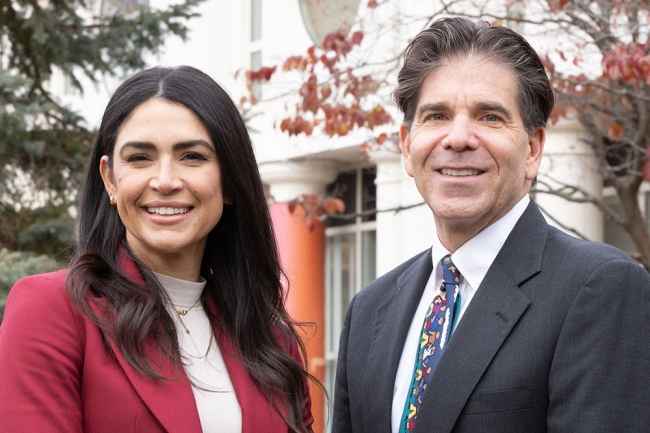
Fairlee C. Fabrett, PhD, and Daniel P. Dickstein, MD, FAAP (R)
Enter donors—and National Council members—Cindy and Paul Gamble, and Ann O’Keefe.
“We give to McLean because we want to be part of hands-on research that has meaningful impact on people struggling with mental health challenges,” said Cindy. “Dr. Dickstein spoke to us about his work with adolescents with irritability issues and OCD, and his use of sensor caps to monitor responses to different social stimuli.
His passion was impossible to ignore. He identified the need for more sensor caps and how the current funding climate was making that difficult. We didn’t hesitate. Being able to help in real time on such a fantastic project is exciting and fulfilling for us.”
O’Keefe agrees. “Intervening at early ages in life can profoundly alter or prevent the trajectory of lifelong mental illness,” said Ann.
“I appreciate that Project WearWolf captures data from both brain activity and peripheral body signals related to stress and allows kids to understand their triggers and learn to manage them. This is an invaluable protective factor.”
Intern-alizing Best Practices
In complement to this novel research, the division recently welcomed its third cohort of pre-doctoral interns—three bright, talented young professionals (see below), chosen from 70 applicants nationwide—who are learning and providing clinical care at the same time. Each intern is based in a different child program at McLean.
“As a teaching hospital, and as part of our mission, it is our responsibility to educate and train future clinicians,” said Fairlee C. Fabrett, PhD, director of training and staff development for the division.
“Having our interns on the different units is a win-win: They get hands-on experience and the opportunity to learn from experts in our community, while giving clinicians themselves the ability to grow through providing supervision and training the interns.”
Clearly, donors agree.
“McLean is a special place, and with a growing mental health crisis among adolescents, we desperately need more of what McLean offers,” said National Council member Guy Davidson. “And that is exactly what we’re doing when we support the training of the next generation of child and adolescent mental health professionals at McLean.”
2025-2026 Pre-Doctoral Interns
Hannah Becker, MS – OCDI Jr.
“I’m eager to explore the complexities of providing treatment for OCD at the residential level and learning how to tailor our interventions to meet each patient’s unique needs.”
Emily Hutchinson, MS – McLean SouthEast
“I am excited to be trained across multiple levels of acute care with youth experiencing suicidality and serious mental illness. I’ve learned so much about bringing compassion and clarity to those entering intensive care.”
Isabella Kahhale, MS – 3East Partial Hospital Program
“I was drawn to McLean Hospital because it is a recognized leader in DBT treatment for adolescents with emotional dysregulation and suicidality. I couldn’t imagine a better place to receive such specialized, in-depth training.”